May 3, 2026
How to select peptides for research studies: a complete guide
Learn how to select peptides for studies effectively with our comprehensive guide. Enhance the accuracy and validity of your research today!

How to select peptides for research studies: a complete guide
Imagine your receptor-binding assay returns inconsistent IC₅₀ values across three replicate runs, and the only variable you didn’t fully audit was the peptide batch. This scenario plays out more often than most labs admit. Peptide selection is not simply a procurement task—it is a scientific decision that directly shapes experimental validity, dose accuracy, and reproducibility. Net peptide content typically ranges from 60 to 85%, a figure that diverges substantially from HPLC purity and has direct implications for how you calculate working concentrations. This guide walks you through every stage of that decision, from initial specification to post-receipt verification.
Table of Contents
- Essential requirements and considerations
- Step-by-step process for selecting research peptides
- Common mistakes and troubleshooting in peptide selection
- Verifying peptide quality and ensuring reproducibility
- Our perspective: why rigorous peptide selection matters more than ever
- Where to find high-quality research peptides
- Frequently asked questions
Key Takeaways
| Point | Details |
|---|---|
| Check net content | Net peptide content, not just HPLC purity, determines accurate dosing for studies. |
| Align purity with study | Choose peptides whose purity matches the rigor and requirements of your research. |
| Request quality records | Always obtain certificates of analysis and recent batch test results from suppliers. |
| Verify independent | Critical experiments require in-house or third-party confirmation of peptide identity and purity. |
Essential requirements and considerations
Before you contact a single supplier, you need a clear picture of what your protocol actually demands. Skipping this groundwork is where most selection errors begin. The two most commonly confused parameters are HPLC purity and net peptide content, and conflating them introduces systematic dosing errors that no statistical correction can fix.
HPLC purity measures the proportion of the target peptide relative to other UV-absorbing species in the sample. It tells you how clean the synthesis was. Net peptide content, however, accounts for residual water, trifluoroacetic acid (TFA) counter-ions, acetate salts, and other non-peptide mass that came along for the ride during lyophilization. Net peptide content of 60 to 85% means that a 1 mg vial labeled at 98% HPLC purity may contain as little as 0.60 mg of actual peptide. If your protocol calls for a 10 µM solution and you calculate from nominal mass, you are already underdosing by up to 40%.
Before ordering, collect and confirm the following:
- Amino acid sequence and any post-translational modifications (phosphorylation, acetylation, PEGylation, disulfide bridges)
- Required purity grade matched to your application tier (in vitro screening versus preclinical pharmacology)
- Net peptide content as a distinct value from HPLC purity, ideally supported by amino acid analysis (AAA)
- Counterion identity and load, especially if TFA is present and your assay is sensitive to fluoride interference
- Solubility profile in your intended buffer or vehicle
- Vendor reputation, including third-party testing practices, batch traceability, and GLP-aligned documentation
The guidance for researchers available from quality-focused suppliers can help you map these requirements to specific product specifications before you commit to a purchase.
| Parameter | What it measures | Why it matters |
|---|---|---|
| HPLC purity (%) | Target peptide vs. UV-absorbing impurities | Confirms synthesis cleanliness |
| Net peptide content (%) | Actual peptide mass vs. total sample mass | Determines true working dose |
| Mass accuracy (Da) | Measured vs. theoretical molecular weight | Confirms correct sequence |
| Counterion load | TFA, acetate, or other salts present | Affects cell-based and enzymatic assays |
| Endotoxin level (EU/mg) | Bacterial lipopolysaccharide contamination | Critical for cell culture work |
Getting all five parameters documented before you place an order is not excessive caution—it is the minimum standard for defensible experimental design.
Step-by-step process for selecting research peptides
Once the groundwork is in place, follow this structured process to make scientifically robust choices.
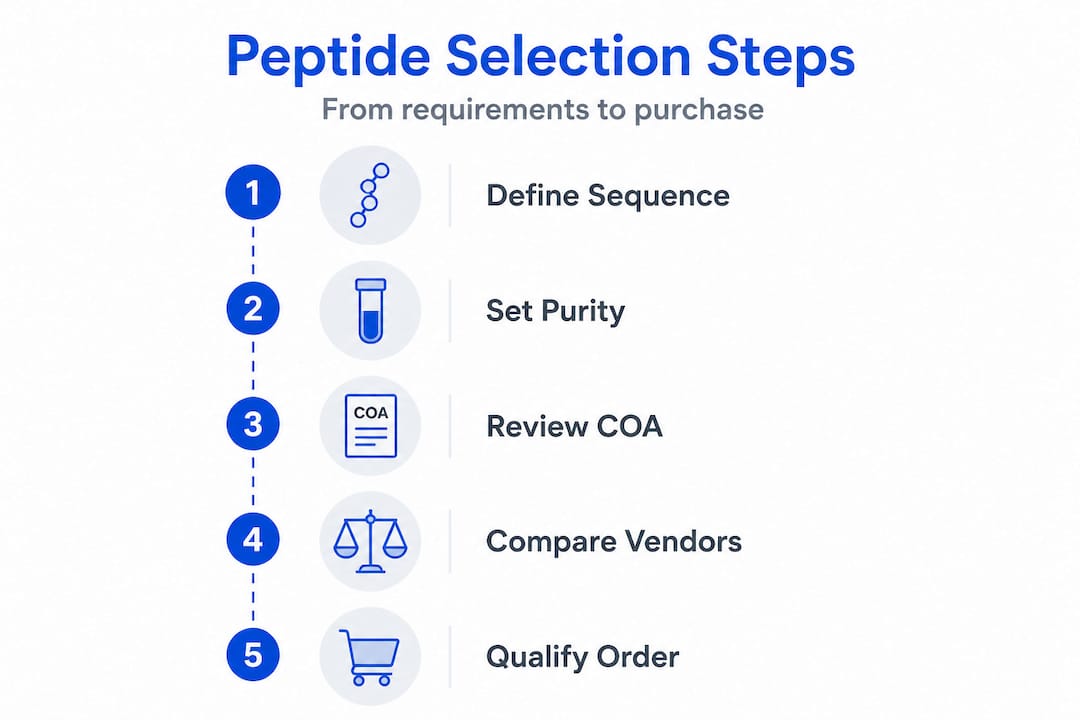
1. Define your sequence and modification requirements precisely. Map every residue, stereochemical configuration (L vs. D), and chemical modification to your experimental hypothesis. A single epimerization at a chiral center can abolish receptor selectivity entirely. If your study involves a cyclic peptide or a stapled helix, confirm the vendor’s synthetic capability and track record for that modification class specifically.
2. Set purity thresholds based on application, not convenience. There is no universal benchmark for peptide purity—the right threshold depends entirely on what you are measuring and how sensitive the assay is. In vitro binding screens can often tolerate 95% HPLC purity, provided impurities are characterized. Pharmacological studies, cell viability assays, and any work feeding into regulatory submissions should target ≥98% HPLC purity with confirmed net peptide content. The key principle: match rigor to stakes.
3. Request and critically review the certificate of analysis (COA). A COA is only as useful as the data it contains. Look for lot-specific HPLC chromatograms, mass spectrometry data, and net peptide content values. Generic or undated COAs are a red flag. The COA should reference the specific batch you are purchasing, not a representative lot from a prior production run.

4. Compare vendors on documentation quality, not just price. Build a short comparison matrix that scores vendors on COA completeness, third-party testing transparency, batch traceability, and responsiveness to technical questions. The premium research peptides guidance from suppliers who publish full analytical data makes this comparison straightforward.
5. Place a qualification order before committing to bulk. For any novel peptide or new vendor relationship, order a small qualification lot and run your own analytical checks before scaling. This step costs a fraction of what a failed study costs.
Pro Tip: For high-stakes studies, always confirm peptide identity with independent mass spectrometry run in your own facility or through a trusted CRO. Vendor MS data confirms the vendor’s synthesis—your own data confirms what you actually received.
| Vendor attribute | Minimum acceptable | Preferred standard |
|---|---|---|
| COA specificity | Lot-referenced data | Lot-specific with raw chromatograms |
| Purity method | HPLC only | HPLC + MS + AAA |
| Net peptide content | Stated on COA | Supported by AAA data |
| Third-party testing | Optional | Routine and documented |
| Batch traceability | Batch number provided | Full synthesis and QC records available |
| Endotoxin testing | Not performed | LAL assay result per lot |
Common mistakes and troubleshooting in peptide selection
Even experienced labs face setbacks—here are pitfalls to watch for and solutions if issues arise.
The single most costly mistake is assuming HPLC purity equals usable peptide mass. A peptide reported at 98% HPLC purity with net peptide content of 65% contains only 65 mg of actual peptide per 100 mg of powder. If your dose-response calculations are built on nominal mass, every data point in your curve is shifted. This error is systematic, invisible in the raw data, and only surfaces when you try to reconcile results across labs or replicate a published protocol.
Common selection and handling mistakes to avoid:
- Ignoring counterion identity. TFA counter-ions are cytotoxic at concentrations commonly encountered in cell culture. If your assay uses mammalian cells, request acetate-exchanged peptides or perform your own ion-exchange step post-receipt.
- Accepting a generic COA. If the certificate does not reference your specific lot number, it provides no meaningful quality assurance for the material in your hands.
- Overlooking synthetic impurities. Truncated sequences, deletion analogs, and oxidation products may not be visible as discrete peaks in a standard HPLC trace but can still influence biological activity at low concentrations.
- Failing to audit batch-to-batch consistency. Even within a single vendor, synthesis scale-up and column changes between batches can shift impurity profiles. For longitudinal studies, lock down a single lot or establish equivalence testing between lots before switching.
- Storing reconstituted peptides without documentation. Freeze-thaw cycles, pH shifts, and oxidation all degrade peptide activity over time. If you cannot document storage conditions, you cannot rule out degradation as a confounding variable.
“Reproducibility failures in peptide-based studies are rarely caused by bad science. They are almost always caused by undocumented variability in the reagent—variability that was present from the moment of ordering and never caught.”
Pro Tip: Always request a recent, lot-specific COA at the time of ordering—not from the vendor’s website archive. Ask specifically whether the document reflects the batch being shipped to you.
If you receive a peptide and your in-house HPLC or MS does not match the vendor’s COA, do not proceed to biological assays. Contact the vendor immediately, retain the original vials, and document the discrepancy in your lab notebook. Reputable suppliers will provide replacement material or a full analytical explanation.
Verifying peptide quality and ensuring reproducibility
Proper selection is only half the story—final confirmation and solid record-keeping complete the cycle.
1. Perform post-receipt analytical spot-checking. For every new lot, run at least a quick LC-MS check against the vendor’s reported molecular weight and HPLC profile. This does not need to be a full GMP-level analytical package, but it should be systematic and documented. Flag any mass discrepancy greater than 0.5 Da for investigation before use.
2. Confirm solubility under your exact assay conditions. Peptide solubility is highly context-dependent. A peptide that dissolves cleanly in DMSO may aggregate in aqueous buffer at physiological pH. Test solubility at your working concentration in your actual assay vehicle, and document the result as part of the lot qualification record.
3. Establish a formal batch record for every peptide lot. The record should capture: vendor name and lot number, COA data, receipt date, storage location and conditions, reconstitution details (solvent, concentration, date, operator), and any observed deviations. This documentation is not bureaucratic overhead—it is the foundation of reproducible science.
4. Cross-reference results with a reference standard. Where a certified reference standard exists for your peptide, run a parallel comparison at receipt and periodically during the study. This gives you a quantitative anchor for activity that is independent of vendor claims. The research-grade peptide standards available from specialized suppliers are designed precisely for this purpose.
5. Archive a reserve aliquot from every lot. Keep a small, unopened aliquot of each lot at the appropriate storage temperature for the duration of the study. If questions arise about reagent quality after data collection, you have material available for retrospective testing.
According to current reproducibility benchmarks, studies that implement systematic reagent documentation and independent verification are significantly more likely to survive peer review scrutiny and inter-laboratory replication attempts. The peptide quality standards community has increasingly moved toward treating peptide characterization as a mandatory methods disclosure, not an optional supplement.
Our perspective: why rigorous peptide selection matters more than ever
The reproducibility crisis in biomedical research has generated enormous discussion about statistical methods, sample sizes, and publication bias. What gets far less attention is reagent quality—specifically, the gap between what a vendor certifies and what actually arrives in the vial.
We see this pattern repeatedly. A lab publishes a compelling result with a novel peptide agonist. A second lab attempts replication with a different lot from a different supplier, uses nominal mass for dosing, and gets a flat dose-response. The conclusion drawn is that the original result was a false positive. In many cases, the actual explanation is a 30% difference in net peptide content between the two lots, combined with an uncharacterized truncation impurity in the replication batch that acted as a partial antagonist.
The no universal benchmark principle cuts both ways. It means you cannot blindly adopt another lab’s purity threshold, but it also means you cannot assume your vendor’s standard offering is adequate for your specific application. Every study tier demands its own explicit quality specification, written into the protocol before ordering begins.
We also push back on the idea that independent verification is only warranted for “critical” work. In practice, every published result is critical once it enters the literature and others attempt to build on it. Treating third-party MS confirmation as a routine step rather than an exceptional one is a cultural shift that the field needs to make. The cost is modest. The benefit to scientific credibility is substantial.
The labs that consistently produce reproducible peptide data share one common practice: they treat peptide characterization with the same rigor they apply to instrument calibration. They document everything, question vendor claims, and verify independently. That discipline is not a burden—it is what separates reliable science from noise. Sourcing from suppliers like premium research peptides platforms that publish full third-party analytical data makes that discipline easier to maintain without adding significant overhead to your workflow.
Where to find high-quality research peptides
If you’re ready to implement a rigorous selection process, sourcing from reputable suppliers is your next step.
ZYNOPEP - Premium Research Peptides is built specifically for researchers who cannot afford ambiguity in their reagents. Every peptide in the catalog ships with a lot-specific COA, third-party HPLC data confirming ≥99% purity, and full mass spectrometry documentation. Net peptide content is reported as a distinct value, not bundled into a generic purity figure.
Temperature-controlled shipping, rapid order processing, and GLP-aligned documentation mean your peptides arrive in the same condition they left the facility—and you have the records to prove it. Whether you are running in vitro receptor assays, pharmacological dose-response studies, or building reference sets for multi-site trials, ZYNOPEP’s catalog and technical support team are structured to meet those demands directly. Reach out for tailored guidance on peptide specification, lot selection, or documentation requirements for your specific protocol.
Frequently asked questions
What is the difference between peptide purity and net peptide content?
Peptide purity refers to how much of the sample is the target peptide relative to other UV-absorbing species, while net peptide content adjusts for water, salts, and counter-ions to reflect the actual usable peptide mass in the vial.
How pure do research peptides need to be?
There is no universal purity benchmark—match the purity threshold to your study’s specific rigor, and use independent verification for any work where data quality is non-negotiable.
What information should I request from a peptide supplier?
Request a lot-specific certificate of analysis, net peptide content data supported by amino acid analysis, synthesis method details, counterion identity, and documented quality control procedures for the specific batch being shipped.
Is it necessary to verify quality in-house after purchase?
Yes, particularly for critical studies—independent mass spectrometry or in-house HPLC spot-checking is strongly recommended to confirm that what you received matches what the vendor certified.